
Guide · not a ranking
How grounding sheets work

A grounding sheet is not a heated blanket and it is not plugged into live power. It is a fitted sheet with conductive fiber, a snap, and a cord that should reach the round ground hole on a three-prong outlet. If that chain is complete, your skin is sitting at earth potential while you sleep. If any link is open, you bought regular bedding with a story attached.
The circuit, in the order it actually fails
Write the path as four parts, because that is how products fail in testing:
- Skin on the conductive face of the sheet (not on a plastic mattress protector).
- Silver (or similar) fiber that still conducts from the middle of the bed to the snap after washing.
- Cord and snap that have continuity of their own — these break more often than brands admit.
- Outlet ground that is actually bonded to earth, not a bootleg ground or an open third hole.
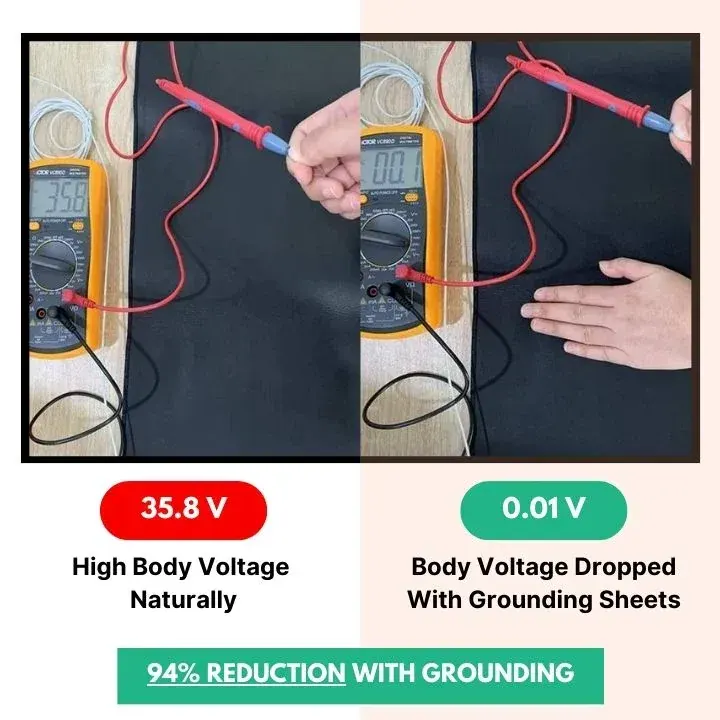
Marketing talks about “electrons from the earth.” The lab version is duller and more useful: you either have a conductive path to the equipment-grounding conductor, or you do not. A $15–$40 multimeter answers that in five minutes. Sleep-score screenshots do not.
That is why this site’s field report starts with a meter, and why the Top 5 ranking drops kits that look premium in photos and read open on the probes.
What the wall is doing
A US 15-amp receptacle has hot, neutral, and ground. The grounding sheet cord is supposed to use only ground. Inside the wall, that conductor should run back to the panel and to a grounding electrode (rod, water pipe bond, or Ufer, depending on the house).
Old bedrooms often fail here:
- Two-prong outlets — no equipment ground at all.
- Three-prong faceplates on two-wire cable — the extra hole is decorative.
- Open ground on a tester (two amber lights missing the ground indication).
- A GFCI that is wired backwards, or a downstream “ground” that was never landed.
A plug-in outlet tester is the cheapest part of this hobby. If the tester says open ground, stop shopping for sheets. No brand can invent a rod in the yard. If you are in a rented place and cannot rewire, a grounding mat on a verified grounded desk outlet in another room is sometimes the only honest option — see sheet vs mat.
GFCI protection and grounding are not the same thing. A bathroom GFCI can trip and still have a working ground, or it can sit on an ungrounded circuit and still trip on imbalance. Test; do not infer from the little “TEST” button.
Why silver percentage is on every decent review
Silver is used because it stays conductive when it is woven as fiber, not because “more metal equals more wellness.” Two construction methods show up in the kits we bought:
Woven or knitted conductive yarn. Silver-coated nylon or similar is spun into the fabric. You can usually see a faint grid or heather. This is what BareEarth lists at about 10% on the kits we measured, and what Terra and Heal Naturally sit closer to 5% on. Higher loading tends to mean a more even path across Queen/King, until wash cycles chew the yarn.
Surface coating or sparse print. Cheap listings under a typical “wellness sheet” price often paint or print a conductive layer. Out of the bag it may beep on a meter. After a few hot washes it flakes, and corners go open. That is a product defect, not “the earth quota running out.”
Percentage is not a medical dose. A 10% weave that survives laundry beats a 20% claim on a coating that does not. We still re-test after wash because brands do not publish a decay curve. EcoHeal’s kit looks generous on paper (sheet plus eye mask) and still had reports of cables with no continuity — the accessory can fail the circuit even when the cloth looks silver.
How to test a sheet yourself
You do not need a lab. You need dry fabric, a meter that can read resistance, and patience with probe contact.
- Unplug the cord from the wall. You are testing the product, not the house, in this step.
- Clip or press one probe on the sheet’s snap (or on a known conductive patch next to it).
- Walk the other probe to the opposite corner, then the middle, then the foot of the bed. You want a path, not one lucky thread.
- Test the cord by itself: snap end to the ground pin. A dead cord is a common “sheet stopped working” ticket.
- Plug into a tested outlet only after the fabric and cord both pass.
Probe pressure changes the number. Compare corners on the same sheet with the same pressure. If one corner is a dead open and the snap area beeps, the weave is patchy — we saw that pattern more on budget Amazon pieces than on the official-store kits in the ranking.
Body-voltage pens and “outlet checkers that light up green on the sheet” are optional extras. They can lie if the house ground is fake. The resistance map on the fabric is the part you can defend.
What you put on the bed can break the path
A conductive fitted sheet under a thick wool blanket still works if skin hits the sheet. It stops working if you add:
- A waterproof vinyl or polyurethane mattress encasement between you and the silver.
- A memory-foam topper with a slick insulating cover as the sleep surface.
- Rubber-backed “stay-on” pads.
Cotton or linen between you and the sheet is a maybe: thin layers still leak some contact through arms and legs; a full insulated sleeping bag does not. Pets that shred fitted corners are a real drawback on deep-pocket sheets that already struggle to stay on (GroundLuxe had corner-slip reports in our notes). That is a mechanical fail, not a spiritual one.
Wash cycles are part of the circuit
Silver yarn does not like bleach, fabric softener, or a hot dryer. Softener coats the fiber; bleach attacks the metal; high heat embrittles coatings. If you need hotel-laundry settings, this category is the wrong bedding.
We treat first-week continuity and post-laundry continuity as two scores. Several sheets that passed unboxing lost a large share of conductivity after repeated washes. That is why “it beeped at my kitchen table” is not a review. If a brand will not tell you how to wash, assume they have not measured decay.
What a meter does not prove
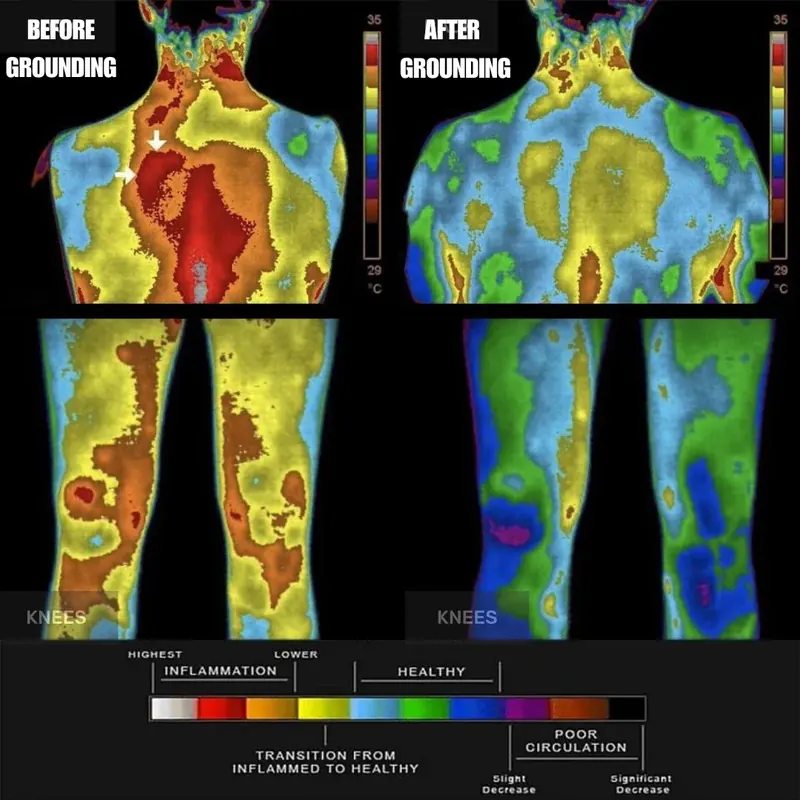
Continuity proves the fabric can carry a signal to ground. It does not prove:
- Better sleep, lower cortisol, or less pain — those need controlled studies, not a shopping page.
- That every night will feel the same. Humidity, sweat, and how much skin is on the cloth all move the reading.
- That a 50% off badge means the physics improved.
Our investigation is explicit about n=1 wearables. Use it as “this kit conducted and I kept it on the bed,” not as a diagnosis. Nothing here is medical advice.
Safety notes we actually mean
Do not clip a grounding sheet to a radiator, a water pipe you have not confirmed as bonded, or a random screw in a junction box. Do not modify the cord to defeat a GFCI. Do not use a damaged cable with exposed conductor. If you have an implanted electrical device, this page is not your clearance — ask the clinic that follows you.
Static shocks after you get into bed usually mean the house or the flooring, not “too much grounding.” Unplug and re-test the outlet before you blame the brand.
What to read next
If the circuit makes sense and you need a buy list, use how to choose, then the Top 5 ranking (BareEarth stays #1 on this SEO site). If you still think the whole category is a commercial, read the 10-week investigation first.
Frequently asked questions
Q: Does current flow through a grounding sheet?
A: Not household current. The live and neutral pins are not used. The cord’s job is to tie the fabric to the round ground pin so the sheet sits at earth potential. If you feel a tingle, unplug and check the outlet with a tester — that is a wiring problem, not “the product working.”
Q: What should a multimeter show?
A: On a working woven-silver sheet, resistance from the snap to far corners is low and fairly even. Coatings and low-silver Amazon sheets often read open or wildly uneven. Exact ohms vary by meter and probe pressure; the useful test is “path exists across the bed,” not a magic number from an ad.
Q: Can I use a grounding sheet on a two-prong outlet?
A: No. Two-prong walls have no equipment ground. A cheater plug that lifts the ground pin also breaks the product. Fix the receptacle or skip the category.
Q: Do I need to sleep naked on the sheet?
A: You need skin on the conductive fabric. Thin cotton pajamas still work for arms and legs that touch the sheet. Thick insulated layers, rubber-backed mattress pads, and waterproof covers can block the path.
Q: Is this medical treatment?
A: No. Continuity is physics. Sleep or inflammation claims are not proven by a meter. If you have a pacemaker or implant, talk to a clinician before using conductive bedding.

Stephanie tests conductive bedding with a meter and sleep tracking.