
Guide · sheet vs mat
Grounding sheet vs grounding mat
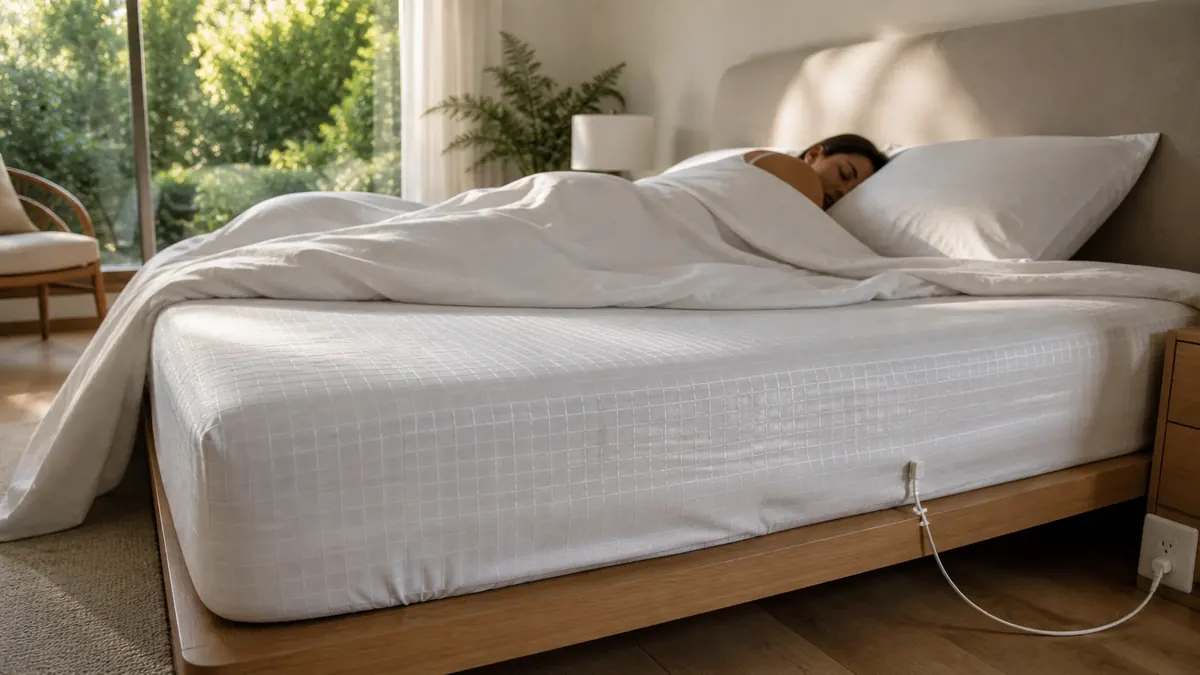
Both products try to do one electrical job: connect skin to a grounded outlet. They are not interchangeable SKUs. A sheet is for hours you are already horizontal. A mat is for a desk, a sofa, or a strip at the foot of the bed. Pick by contact time and whether you will actually keep skin on the conductor — not by which ad loaded first.
Same physics, different surface
Silver (or carbon) conductor → cord → round ground pin. That is the whole trick, and it is explained without shopping language in how grounding sheets work. A mat that fails continuity is as useless as a sheet that fails it. Coatings still flake. Cords still die. Ungrounded outlets still zero out the category.
The useful comparison is hours of skin contact and how many ways you can accidentally insulate yourself.
Side-by-side
| Fitted grounding sheet | Grounding mat / pad | |
|---|---|---|
| Typical contact | Back, sides, arms during sleep (if skin hits the cloth) | Feet, wrists, or a small patch you remember to use |
| Hours if you use it | A full night, passively | Work block or TV hour — easy to forget |
| Size constraint | Must match Twin / Full / Queen / King; some kits stop at Throw or Queen | One rectangle; no mattress pocket depth |
| Wash | Gentle cycle; no bleach or softener; heat kills coatings | Wipe-down more common; still do not bleach conductive faces |
| Easy to fail | Waterproof encasement, deep-pocket slip, dead snap | Socks, shoes, sitting on the sofa instead of the mat |
| Travel | Bulky; hotel grounds are unreliable | Packable; still needs a real ground |
None of those rows is a reason to invent “low stock.” Size gaps and wash rules are the honest cons. BareEarth’s ranking notes include real limits like Throw vs Queen availability on related kits; we keep those as size facts on the sheet ranking.
When a fitted sheet is the better buy
Buy a sheet if the point is sleep and you will actually lie on it. You already spend seven or eight hours in bed. You should not have to remember to rest a wrist on a 12-inch pad at 1 a.m.
That is why our overnight tests use sheets, not a desk tile. A wearable only has a chance to show a pattern if the conductor is there all night. A mat you used for two hours at a laptop is a different experiment — do not mix those graphs.
Sheets lose if:
- Your mattress size is not sold (King shoppers walking into a Queen-only kit).
- You need a waterproof medical encasement that never comes off.
- You share a bed with someone who will not wash silver yarn on the gentle cycle.
- The fitted corners pop off a thick mattress — we logged slip reports on GroundLuxe, plus a 13-inch pocket cap.
Those are product geometry problems. They belong on the spec card. They do not belong in a countdown bar.
When a mat is enough (or better)
Buy a mat if you want a trial without changing the whole bed, if you work at a desk in socks, or if the only verified ground in the apartment is in the office, not the bedroom.
Mats lose if you wear shoes all day, if the “leather” face is a plastic insulator with a tiny conductive window you never hit, or if you roll it up and forget it. Passive beats virtuous. A sheet you ignore still covers you. A mat you ignore is a placemat.
Some sheet kits include a small mat. Treat it as a spare conductor for a keyboard tray. Do not let the bonus mat raise the sheet’s rank. We score BareEarth as a sheet because the fitted cloth conducted after wash, not because a extra square arrived in the box.
Mattress strips and “half sheets”
There is a third shape: a conductive runner you park under the fitted cotton you already own, or a half-sheet that only covers the torso. In theory you get sheet-like hours without replacing the whole set. In practice the runner migrates, wrinkles into an insulating air gap, or never reaches the snap after you make the bed.
If you go that route, meter from the sleep surface — the cotton you actually touch — down to the snap. If that sandwich reads open, you built a decoy.
Do you need both?
Usually no. One verified path you will keep using is worth more than a sheet plus a mat plus a pillowcase from three brands. If the bedroom outlet is ungrounded, buying two products doubles the waste. Test the receptacle first with a plug-in tester, then decide the shape.
Two products can make sense when the sheet is for night and a mat is for a home-office you already sit at barefoot. That is two use-cases, not “stacking earth energy.”
Pets, kids, and shared beds
Dogs that dig at fitted corners will destroy a silver sheet faster than a wipe-clean mat. Crib and toddler beds often have no honest size in adult grounding kits — do not stretch a Twin and call it safe. Kids also wash bedding on whatever cycle the household uses; silver yarn loses that fight.
For a shared adult bed, agree on wash rules before you buy. One person running bleach is enough to kill conductivity for both.
What this site actually ranks
The money pages here are fitted sheets, because we can test them overnight with a meter and a wearable under one protocol. Start with the Top 5 ranking if you already want that shape. Use how to choose if you are still on outlet / silver / size. Mats are discussed so you do not buy a Queen kit when a pad would have matched the room you actually occupy.
Frequently asked questions
Q: Is a grounding mat the same as a grounding sheet?
A: Same electrical idea, different contact area and hours. A fitted sheet is the sleep surface. A mat is a pad you sit, stand, or rest a limb on. A dead outlet ground fails both.
Q: Can I put a mat under the fitted sheet?
A: Only if the mat is designed as a mattress pad and the sleep surface still lets skin reach a conductor. Stacking a vinyl mat under a regular cotton sheet often insulates you from the silver. Read the kit; do not improvise a sandwich.
Q: Which is cheaper to try?
A: Mats are usually the smaller spend and easier to return. Sheets cost more and need the right mattress size. Cheap mats have the same coating-vs-weave problem as cheap sheets.
Q: Do I need both if a sheet kit includes a small mat?
A: No. Score the sheet as a sheet. The throw-in mat is a bonus for a desk or feet, not proof the fitted sheet is #1.
Q: What if I travel?
A: A compact mat in a laptop sleeve is easier than packing a Queen fitted sheet and hoping the hotel outlet is grounded. Many hotel rooms are not. Test or skip.

Stephanie tests conductive bedding with a meter and sleep tracking.